12-Month Taiwan Hotel Internship for Vietnamese Students in F&B, Accommodation and Kitchen
A hotel internship changes quickly when it lasts a full year. The first weeks are about learning where things are, how guests are greeted, and what standards the hotel expects. By the third month, the work starts to feel natural. By the end of 12 months, a student can leave with real operational confidence, better language ability, and a clearer view of a future career in hospitality.
For Vietnamese college and university students, Taiwan offers a strong setting for this kind of training. Hotels in Taiwan serve local guests, regional travellers, business visitors, tour groups, and international tourists. That mix creates daily chances to practise service skills, use English and Chinese, and understand how hospitality teams work across cultures.
A 12-month Taiwan hotel internship for Vietnamese students in F&B, Accommodation and Kitchen is not only a line on a CV. It can become a bridge between classroom learning and full-time employment after graduation.

Why Taiwan is a strong place to build hotel experience
Taiwan is well placed for students who want hotel experience in an international tourist environment. It has a developed hospitality sector, a strong service culture, and close regional links across Asia. For Vietnamese students, the location is also practical. Taiwan is relatively close to Viet Nam, and its tourism and hospitality industries are familiar with guests from different Asian markets.
The value of an internship in Taiwan comes from the pace and variety of hotel work. A hotel is not one workplace. It is many workplaces under one roof.
There are guest-facing teams, back-of-house teams, cleaning teams, kitchen brigades, banquet crews, reservations staff, and duty managers. Each team depends on the others. A small delay in room readiness can affect front desk service. A kitchen timing issue can affect restaurant satisfaction. A missing housekeeping detail can affect a guest review.
Students begin to understand these links through daily work, not only through lectures.
A 12-month placement also gives enough time to observe seasonal changes. Tourist flows can shift during holidays, weekends, group travel periods, and special events. Students see how hotels plan staffing, handle busy mealtimes, prepare rooms, and respond to guests when pressure rises.
That long exposure is one of the biggest benefits. Short internships may offer a simple introduction. A full-year placement allows students to build habits, correct mistakes, and become much more useful to a hotel team.
What students can learn in Food and Beverage
Food and Beverage, often called F&B, is one of the most active training areas in a hotel. It includes restaurants, cafés, breakfast service, banquets, room service, and sometimes bars or event dining, depending on the hotel.
For many students, F&B is the best place to learn guest service quickly because the guest interaction is constant. Staff need to smile, listen, move fast, remember requests, and solve small problems before they grow.
During a 12-month internship, students may gain experience in areas such as:
Welcoming guests to the restaurant
Setting tables and checking dining areas
Taking basic orders under supervision
Serving food and drinks
Clearing tables and resetting service stations
Supporting buffet breakfast operations
Helping with banquet or event service
Understanding hygiene and food safety routines
Communicating guest requests to the kitchen
F&B teaches timing. A guest should not wait too long to be seated. Food should arrive at the right temperature. Plates should be cleared without making the guest feel rushed. These details are easy to describe in class, yet they become real only through practice.
Students also learn how to read a dining room. A table looking around may need help. A family with children may need faster assistance. A guest with a dietary question needs a careful answer, not a guess.
These small moments build service judgment. That judgment is valuable after graduation because employers want graduates who can think on the floor, not only follow instructions.

What students can learn in Accommodation and rooms division
Accommodation training gives students a close look at the part of the hotel that guests often remember most: the room.
This area may include housekeeping, room inspection, guest floor service, laundry coordination, and support for front office operations. Some placements may focus more on rooms maintenance and cleanliness, while others may include limited guest contact. The exact duties depend on the hotel, the host department, and the student’s training plan.
Accommodation work builds discipline. Rooms must meet standards every time, not only when the hotel is quiet. Beds need to be properly made. Amenities need to be complete. Bathrooms need careful attention. Lost-and-found procedures need to be followed. Privacy must be respected.
Students may learn to:
Prepare guest rooms according to hotel standards
Restock amenities and housekeeping supplies
Report room defects or maintenance issues
Support room checks before guest arrival
Understand linen handling and laundry flow
Follow safety and privacy rules on guest floors
Communicate room status with supervisors or front office teams
This training builds respect for detail. A clean room is not only about appearance. It affects guest trust, comfort, health, and the hotel’s reputation.
Students who experience accommodation operations also gain a better understanding of teamwork. Front desk staff may promise an early check-in, but housekeeping must prepare the room. A guest may request extra towels, but floor staff need to deliver them quickly. A room may look ready, yet an inspector may find something that must be corrected.
By working inside this system, students learn how service quality depends on many small actions done well.
What students can learn in hotel kitchens
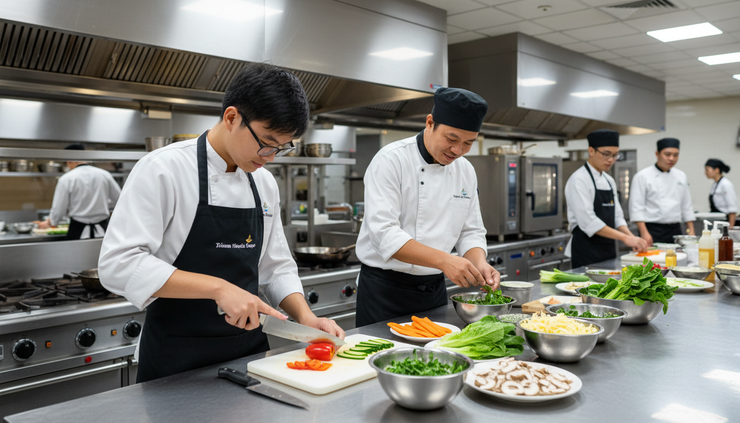
Kitchen internships are demanding, but they can be deeply useful for students who want practical hospitality experience. A hotel kitchen has strict routines, clear roles, and high standards for hygiene, timing, and teamwork.
Students may assist with preparation rather than advanced cooking, especially at the beginning. This is normal. Kitchen work requires trust. Interns often start with simple tasks and grow into more responsibility as supervisors see their reliability.
Possible learning areas include:
Washing, cutting, and preparing ingredients
Helping with breakfast, buffet, or banquet preparation
Supporting cold kitchen or pastry tasks where suitable
Keeping workstations clean and organised
Learning basic storage and labelling routines
Following food safety and hygiene rules
Understanding how kitchen teams prepare for peak hours
The kitchen teaches planning. Before service begins, ingredients must be ready, tools must be clean, and stations must be arranged. During service, the team must communicate clearly and move with care.
Students also learn that hotel kitchens serve different guest needs. A breakfast buffet may need speed and volume. A banquet may need consistent plating for many guests. A restaurant may need more attention to individual orders. Each service style trains a different kind of discipline.
For students who want future roles in culinary operations, restaurant management, catering, or hotel supervision, kitchen exposure gives a strong foundation. Even students who do not plan to become chefs benefit from learning how food service works behind the scenes.
Cross-cultural experience matters in hospitality
Hospitality is built on human interaction. Technical skills matter, but the best hotel staff also understand people. A Taiwan internship gives Vietnamese students daily practice in working with colleagues and serving guests from different cultural backgrounds.
This is useful because international tourism does not follow one service style. Guests may have different meal habits, communication styles, expectations about privacy, and ideas about what good service looks like.
Some guests want warm conversation. Others prefer quiet efficiency. Some ask many questions. Others expect staff to notice their needs without being asked. Students who work in an international hotel environment start to recognise these differences.
Cross-cultural experience also helps inside the hotel team. Students may work with Taiwanese supervisors, local colleagues, other interns, and staff from different countries. This teaches patience, listening, and respectful communication.
Common learning moments include:
Understanding indirect communication at work
Asking supervisors for clarification politely
Serving guests who speak different languages
Adjusting service style for families, solo travellers, or tour groups
Handling feedback without taking it personally
Respecting workplace habits that may differ from Viet Nam
These experiences are not always easy. A student may misunderstand an instruction. A guest may speak quickly. A supervisor may correct a mistake in a direct way. Yet these moments often become the most valuable part of the internship.
A graduate who has already worked across cultures is usually more prepared for hotels, resorts, airlines, restaurants, cruise lines, and tourism companies after graduation.
Language immersion improves English and Chinese in real situations
Language learning changes when it happens during work. In a classroom, students practise with textbooks and planned conversations. In a hotel, language is tied to real tasks, real guests, and real pressure.
A Taiwan internship can support both English and Chinese language immersion. English is often used with international tourists. Chinese is useful for local guests, Taiwanese colleagues, signs, menus, forms, and daily life outside work.
Students may practise English when they:
Greet international guests
Explain restaurant items
Answer simple questions about hotel facilities
Confirm room numbers or requests
Apologise and ask a supervisor for help
Communicate with non-Vietnamese colleagues
Students may practise Chinese when they:
Follow workplace instructions
Read basic hotel terms
Speak with local staff
Handle simple guest requests
Navigate transport, food, and daily errands
Build confidence in everyday conversation
The goal is not perfect fluency after one year. The real benefit is confidence. Students learn to speak even when they are not sure of every word. They learn useful hotel phrases and polite expressions. They also learn body language, tone, and timing.
This matters for future job placement. Employers often value graduates who can communicate with different guests, stay calm during service, and learn language through real contact.
A 12-month internship can improve job placement after graduation
Hospitality employers often look for graduates who can move from training to work with less adjustment. A full-year hotel internship helps because it shows more than interest. It shows stamina, practical exposure, and workplace maturity.
After 12 months, students can usually explain what they did in specific terms. That helps during interviews.
Instead of saying, “I studied hotel management,” a graduate can say:
“I completed a 12-month hotel internship in Taiwan, with practical training in restaurant service, room operations, and kitchen support. I worked with international guests and used English and Chinese in daily service situations.”
That kind of answer gives employers something concrete to evaluate.
A long internship can help students build:
A stronger CV
Real examples for interviews
Better service confidence
Workplace references, where available
Clearer career goals
Better language ability
More understanding of hotel standards
It can also help students decide which path suits them. Some may discover that they enjoy restaurant service. Some may prefer rooms division. Others may find interest in kitchen operations, guest relations, or future supervisory roles.
This clarity is valuable. The first job after graduation can shape the next few years of a hospitality career. Students who know their strengths can choose better and perform with more purpose.

What students should prepare before applying
A successful internship starts before arrival. Students should understand the purpose of the programme, the likely duties, and the expectations of the host hotel.
Before applying, students should prepare:
An updated CV in English
A clear statement of interest
Basic English communication ability
Willingness to learn Chinese
A neat and service-minded personal presentation
Physical readiness for shift work
A positive attitude towards routine tasks
Openness to feedback from supervisors
Students should also check the official requirements through their college, university, internship organiser, or host institution. Details such as eligibility, training scope, accommodation, insurance, visa rules, work permissions, allowance, and documents must be confirmed through proper channels.
A hotel internship is practical training, not a holiday. Students may work early mornings, evenings, weekends, or public holidays, depending on department schedules. F&B and kitchen roles can be physically demanding. Accommodation roles require speed and attention to detail. Guest-facing work requires patience even on tiring days.
The right mindset makes a big difference. Students who treat small tasks seriously often earn more trust. A clean station, a correctly set table, a properly prepared room, or a polite guest greeting can show supervisors that a student is ready for more responsibility.
How to make the most of the 12 months
The best internship results come from active learning. Students do not need to wait for someone to teach every lesson. They can observe, ask, record, and reflect.
A useful habit is to keep a simple learning journal. It does not need to be long. After each week, students can write down:
New English or Chinese phrases learned
Tasks completed for the first time
Mistakes and how they were corrected
Guest situations observed
Questions to ask a supervisor
Skills that need more practice
Over time, this journal becomes a source of interview stories. It also helps students see their own progress.
Students should also ask for feedback in a respectful way. A simple question such as “How can I do this better next time?” can open the door to useful guidance.
Another smart step is to rotate learning attention, even if the assigned department stays the same. An intern in F&B can observe how the kitchen communicates during breakfast. An intern in accommodation can notice how room status affects front office work. A kitchen intern can learn how banquet orders and guest timing affect preparation.
Hotels run on connections between departments. Students who understand those connections become more flexible and employable.
The long-term value of a Taiwan hotel internship
A 12-month hotel internship in Taiwan can give Vietnamese students four things that are hard to gain from classroom study alone: practical skill, cultural confidence, language exposure, and clearer career direction.
F&B builds guest service and speed. Accommodation builds discipline and attention to detail. Kitchen training builds teamwork, hygiene awareness, and respect for preparation. The international hotel environment adds cross-cultural learning every day. English and Chinese immersion turn language from a subject into a working tool.
The strongest outcome is not only a certificate or completed placement. It is the confidence to walk into a hotel after graduation and understand how service really works.
For students who want a future in hospitality, tourism, restaurants, resorts, or international service roles, a year in Taiwan can be a serious advantage. It offers time to grow, make mistakes, improve, and return home with experience that employers can recognise.


